Thursday, 23 March 2017

Suffrage in Utah & President Obama's rhetoric

Suffrage in Utah, 1870-1896.

Twenty-six years before even being admitted into the Union and granted formal statehood, Utah territory gave women the vote in 1870. This followed Wyoming territory which had passed female suffrage laws by December of 1869 and accordingly, was considered a groundbreaking piece of territorial legislature. 

However, most interesting to the history of women's suffrage in Utah was its alliance to the Mormon religion to which the overwhelming majority of Utahns belonged. Mormonism, or the Church of the Latter-Day-Saints is a somewhat radical branch of traditional Christianity holding a variety of beliefs that draw distinctions from many traditional elements of Christian faith - the most notorious of which is a belief in polygamy as a cornerstone of the familial unit and of a human's bond with his/her partner(s) and their creator. Ultimately, it was debates surrounding the practice of polygamy that came to shape Utah's history of female suffrage rather than the traditional motive of gender equality. 

During the early 1870s, Congress became increasingly concerned with polygamy and its impact, specifically within Utah where it was centered. As a result, many congressional anti-polygamy bills were drawn up and proposed to Congress, reaching various stages of ratification. This provoked predominantly female groups in Utah to campaign for their own suffrage so that they might vote to oppose such bills that they felt violated their religious freedom and way of life. While Utah did not have formal representation in congress, it could nonetheless influence Congressional decisions to a degree and vote in Presidential Primaries. As Carol Madsen writes, "Though far removed from the centers of agitation for women's suffrage [Utahn women were...] aware of efforts for a national suffrage act" they were simply unmotivated, seemingly content in their semi-frontier lifestyle. Ultimately, it was specific threats to their polygamy which provoked mass rallies of women asserting their right to "rise up [...] and speak for ourselves", earning recognition from territorial legislature who were encouraged by national campaigns for female suffrage, granting Utahn women the right to vote on February 12th, 1870. Particularly interesting is how these women show an early use of traditional feminist rhetoric, yet implement it in campaigns whose feminist qualities were purely incidental to their religious motivations. More ironic is the fact that, the practice of polygamy is easily interpreted as an anti-feminist ideal, granting men a higher status within society while simultaneously reducing women to an objectified and quantified resource. 

An anti-polygamy bill known as the 'Edmunds Act' removed the vote from polygamists in 1882 and was followed by the 'Edmunds-Tucker Act' which, despite the efforts of the Utahns, passed in 1887 to restrict many Mormon practises. One clause of this bill removed women in Utah of their right to vote, overpowering the previous territorial legislature in an attempt to dissuade dissent and political campaigning against the 'Edmunds-Tucker Act'. The passing of this act was met with much resistance from Utahn women who had enjoyed voting rights for seventeen years. They quickly realised that the best method through which they might obtain voting rights was through statehood under equal suffrage laws, something that materialised on January 4th, 1896. 

President Obama's Rhetoric

By the time President Barack Obama took office in January 2009, legal equality had been largely established between women and men, yet as a self-identified feminist, Obama continued to champion gender equality through enhancing pre-existing legislation and through his rhetoric which aimed to sway hearts and minds. Indeed, Obama concedes that "there are some changes that have nothing to do with passing new laws" and "the most important change may be the toughest of all - and that's changing ourselves".

In 2009, Obama created the 'White House Council on Women and Girls' in order for federal agencies to "take into account the needs of women and girls in the policies they draft, the programs they create, the legislation they support [...] to ensure that in America, all things are still possible for all people". Here, Obama invokes sentiments of the American dream, using this standard political device of America as a land of freedom to appeal to his entire audience, irrespective of partisan allegiance. Nonetheless, he seems to hint at an acknowledgement of the role partisan politics might play, specifying "the legislation they support" as something to be considered under this new council. This is because representatives of a certain party carry certain expectations and ideals from a coalescence of their electorate, their party goals and their personal conscience. This recalls the early suffrage movements of states and territories like Utah in the 1870s where voting power was measured more in terms of its effects on political representation rather than any kind of feminist progress. Nonetheless, in trying to reinforce gender equality within preexisting areas of the federal government, Obama has done his best to manifest his own beliefs in a way that remained difficult throughout his two terms given the scope of America and its inhabitants with their geographical-dependent beliefs and religious views.


Bibliography


Suffrage in Utah, 1870-1896 - Sources/Further Reading

Alexander, Thomas G."An Experiment in Progressive Legislation: The Granting of Woman Suffrage in Utah In 1870" Utah Historical Quarterly Vol. 38, No. 1 (1970): pp. 20-30.

Madsen, Carol Cornwall. "Woman Suffrage" in Encyclopedia of Mormonism. New York, NY: MacMillan Publishing, 1992.

White, Jean Bickmore. "Women's Suffrage in Utah" in Utah History Encyclopedia. Retrieved from <http://historytogo.utah.gov/utah_chapters/statehood_and_the_progressive_era/womenssuffrageinutah.html> Last accessed 23/03/2017.

Channel 4 Documentary - Three Wives, One Husband, 2017. Review: https://www.theguardian.com/tv-and-radio/2017/mar/24/three-wive-one-husband-review-channel-4

President Obama's Rhetoric

Merod, Anna. "Obama Calls for Cultural Shift to End Gender Inequality" NBC News, August 4th 2016. Retrieved from <http://www.nbcnews.com/politics/barack-obama/obama-calls-cultural-shift-end-gender-inequality-n622996>

Reno, Annika. "A Look at Obama's Legacy on Women's Rights" Global Citizen, July 29th 2016. Retrieved from <https://www.globalcitizen.org/en/content/white-house-legacy-on-womens-rights/> last accessed 13/03/2017.


Sunday, 19 March 2017

Drilling down in the Wilderness on USSO


My visit to the USSO site - an exercise in reflexive learning

This was my first visit to the U.S. Studies Online and I could immediately appreciate the sheer breadth of its offering just from the home page. However, I remembered the good tips learnt from ‘Reading Academic Texts’ workshop, and therefore planned to skim and scan the structure before plunging into the task. The site has academic credibility and authority and is affiliated to a credible organisation, the British Association for American Studies (BAAS). The mission statement was a model of clarity and enabled me to understand the purpose and direction of the site. I noted the wide range of research topics covered in this ‘unique hub that is of interest to us all.’[1] I also appreciated that the research is very up to date. Due to the richness of the site, I soon realised that I would have difficulty in deciding the topic for my blog task. This was a useful challenge as it meant that I spent more time in researching how the editors categorise the many layers of information.

To provide a focus for the exploration of the site I decided to use the topics which I had already worked on for the recent key word assignment in semester 2. This would make my site research meaningful and focused and would relate to previous learning. It would also provide me with more knowledge and understanding of those topics where I had undertaken individual research. I also felt that by being exposed to much good writing in a creditable academic site would help my development of critical analysis.

My three key word topics were Wilderness, Native Americans and First Wave Feminism. Although I was very tempted to revisit all three terms for further investigation, I have spared my readers the task of ploughing through such mountains of what I accept is second hand research! Therefore, I hope you enjoy these few nuggets pulled from the USSO treasure chest.

Twilight in the Wilderness (1860) by Frederic Edwin Church

I chose to begin with the search term Wilderness. This uncovered a treasure trove of ideas and approaches.  I followed links to research articles on:
·      nightime as a new frontier,
·      a new perspective on the post-World War 1 Mid-West
·      the notion of ‘air space’ as another frontier
·      cultural similarities between civil rights movements
·      a review of a television series about the successes of a Russian spy ring living as American citizens
·      a review of ‘The Myth of Emptiness’ which situates the book at the heart of current debates about ideological constructions of wilderness, covering cultural, geographical and theoretical backgrounds

And finally, a most useful introduction to the world of podcasts where I located ‘Back Story’ – presented by three historians aiming to 'bring historical perspective to the events happening around us today.'

 http://backstoryradio.org/shows/worlds-apart/

 I found these approaches to Wilderness particularly interesting because of the links made with new topic areas within American Studies. They point up as to how much frontier and wilderness are featured within American cultural studies and how often are linked to the American psyche.


[1] Dr. Sue Currell is a Reader in American Studies at the University of Sussex 

Friday, 17 March 2017

'Beyoncé’s ‘Lemonade’: A Complex and Intersectional Exploration of Racial and Gendered Identity'


In Juliet Williams' article on Beyoncé's 'Lemonade', the increasingly profound and provocative nature of her feminist and race-oriented work is described and explained within its context of an America in the midst of waves of ethnic particularism and ongoing oppression. 

Williams' begins with an overview of Beyoncé's deconstruction of the traditional structures of feminist movement, re-imagining them with women of colour at the "front and centre of the narrative". In doing this, Beyoncé is able to combine two spheres of identity that would usually be considered as quite distinct political movements against oppression - being an African-American, and being a woman. As a figurehead of both communities, Beyoncé is gifted with the perfect stage from which she has been able to launch a barbed assault on the very establishment itself - an assault that is consistently validated by her conveniently intersectional group of fans which journalist Piers Morgan asserts is a result of Beyoncé's status as a "global brand". This is because, not only is she able to relocate counterculture political movements such as 'Black Lives Matter' within the global consciousness of pop culture, she is able to do so in a way that negates much critique as this only strengthens her cause by portraying her as an attacked figure, generating much backlash from her like-minded fans. Furthermore, embodying and providing a voice for what is regarded in this context as society's perpetual victim, Beyoncé sets the scene for an archetypal hero narrative wherein she overcomes her oppressor and in doing so, becomes an idol for her respective communities. While the overall tone, as outlined in Williams' article is decidedly pessimistic at the state of race and gender relations, there is nonetheless elements of self-empowerment here, invoking sentiments of the American Dream. As Williams' notes, lyrics like "I dream it, I work hard, I grind it 'til I own it" in 'Freedom' prescribe activism which, in this context of race and feminism, invariably translates to forms of militancy, as demonstrated in Beyoncé's 2016 Superbowl half-time performance. 
In this performance, Beyoncé and her army of dancers paid tribute to the Black Panthers, a militant civil rights group whose action against police brutality through separatist ideology often instigated brutality and domestic terrorism in its own right, potentially foreshadowing her use of Malcolm X within Lemonade itself. For those like Piers Morgan, Beyoncé's most outspoken critic since Lemonade, this has proved problematic and indicative of hypocrisy. Morgan describes a conversation he held with Beyoncé in 2011 where she places being "an entertainer and musician" at the forefront of her aspirations. Indeed, she takes delight in subverting the role of race, asserting that "it's not about colour and race, and I'm happy that's changing". Clearly then, something has changed. Specifically, Morgan levels a charge of hypocrisy towards Beyoncé as, in attempting to deconstruct systems of law, society and culture that hold racial-based prejudices - Beyoncé herself advocates black separatism and a focus on militant, race-exclusive action that is seen to undermine her aforementioned goals. Furthermore, hypocrisy might be a conclusion drawn from Beyoncé's pledge for an intersectional feminism. In dismissing the relationship between white female culture and a feminist movement in favour of her own racial identity, Beyoncé again demonstrates a form of separatism that must be reconciled in light of a context of historical and contemporary oppression. A more liberal critic might even take issue with the absence of Native American women, or the transgender community within Beyoncé's narrative. 

Morgan also believes that beneath this activism lies a subtext of self-promotion in order to "shift records and further fill her already massively enriched purse". By definition, there can be no evidence for this but nonetheless, it is worth considering Beyoncé's debated 'oreo' status amid her focus on the "plantation homes [...] antebellum costumes" that, according to Williams' article, cement her inclusion within traditional black culture, irrespective of her actual life and career. This debatable paradox can be taken down to the smallest scale. Take the track 'Don't hurt yourself' wherein Beyoncé enlists the talent of Jack White - a White blues rocker who himself, harbors undying admiration for the Black community within a specifically musical context, as manifested by his appropriation of black culture. This might be read as an insult to the hordes of unsigned black blues musicians that might have made comparably suitable additions to the track yet who are not recognized culturally on account of their colour. However, this might instead be considered as solid proof of what Williams' describes as "current conceptualisations of intersectional 'fourth wave' feminist discourse" - affirming the superfluous nature of skin colour. Another of Lemonade's notable critics is fellow African-American pop singer Azealia Banks who tweeted; "You keep crying over a man and perpetuating that sad black female sufferance and it's Not good for what we're trying to accomplish here". Although the subtext is subject to debate and requires qualification - Banks seems to find a flaw in a feminism that is in, many ways, manifested through sadness over an unfaithful male. 

To conclude, Williams' introduces the startling topicality of issues raised in Lemonade through the specific lens of Beyoncé's own identity and ideas of intersectionality and militancy. Discussions raised here demand further questions into Beyoncé's vision of a post-racial America - centered around her depiction of the Black Panthers, adherence to separatism, her past relationship race, and constructions of her own identity. While Lemonade has been subject to relatively little debate and critique, there is no doubt that Beyoncé has coalesced many voices of anger and confusion into a single coherent march for activism. 

Bibliography


Primary Source - Williams, Juliet. Beyoncé's 'Lemonade': A complex and intersectional exploration of racial and gendered identity. 2016. Retrieved from <http://www.baas.ac.uk/usso/beyonces-lemonade-a-complex-and-intersectional-exploration-of-racial-and-gendered-identity/> last accessed 18/03/2017.


Secondary Sources

Morgan, Piers. "Jay-Z's not the only one who needs to be nervous about Beyoncé, the born-again-black woman with a political mission", Daily Mail Online, 2016. Retrieved from <http://www.dailymail.co.uk/news/article-3557867/PIERS-MORGAN-Jay-Z-s-not-one-needs-nervous-Beyonce-born-black-woman-political-mission.html> last accessed 18/03/2017.

Azaelia Banks on Lemonade, Independent Online, 2016. Retrieved from <http://www.independent.co.uk/news/people/azealia-banks-beyonce-lemonade-antithesis-of-feminism-a7003776.html> last accessed 18/03/2017.

Bale, Miriam. Beyoncé's 'Lemonade' is a revolutionary work of Black Feminism, Hollywood Reporter, 2016. Retrieved from <http://www.hollywoodreporter.com/news/critics-notebook-beyonces-lemonade-is-887240> last accessed 18/03/2017. 


The Origins of American Democracy Promotion: US Studies Online


Introduction: Tracing the Origins


This blog was influenced by Robert Pee’s article featured on ‘American Studies Online’, on ‘The Cold War and the Origins of US Democracy Promotion’, of which traces the  use of American Soft Power to the early 1970s. This blog will first introduce the context surrounding the Cold War and American democratic promotion in relation to Pee’s argument, and will then consider contemporary democratic promotion against the War on Terror.

American Democracy Promotion: Hard and Soft Power during the Cold War

The Cold War was essentially an ongoing confrontation between two world superpowers, America and Russia. This confrontation was a war between the ‘ideologies’ of capitalism and communism. Both countries and ideologies differed in their approaches towards politics, economics, society and culture, with the fundamental beliefs being freedom (capitalism) and equality (communism).


American during this time had a vested interest in influencing democracy abroad, believing that countries would fall to communism. Occasionally this was done through the use of military power, or as critic Nye would call it ‘hard power’. The Vietnam War exemplifies American the use of ‘hard power’ abroad, with America believing if one country in Asia would ‘fall’ to communism, others would follow (the domino theory). This influenced Americans to increase the numbers of military advisers and ground troops in Vietnam, to protect the south from the communist North Vietnam and the rebellious Vietcong. Eventually ‘Hot war’ began with the ‘Gulf of Tonkin Resolution’, in which congress allowed the president to use military force, after the attacks on American naval vessels. Although in Pee’s article ‘The Cold War and the Origins of US Democracy Promotion’, he traces the historical roots of America’s use of ‘Soft Power’ in influencing democracy abroad. Soft power essentially is the use of attraction and persuasion, in comparison to the use of forceful military action.

 Pee claims that America began influencing democracy from ‘1972 onward’. Although, Weissman in his article, ‘Pivotal Politics—The Marshall Plan: A Turning Point in Foreign Aid and the Struggle for Democracy’, claims that America influencing democracy abroad via the use of soft power happened much earlier than 1972. Weismann asserts that ‘the "Marshall Plan," marked a turning point in American foreign policy. It was a reversal from post-World War I (WWI) isolationism and generated long-lasting relations with other nations’. This would suggest the Marshall Plan, (also known as the European Recovery Programme) which was a plan which gave $13 billion to the recovery of Europe after the devastation of the Second World War, allowed European countries to be ‘persuaded’ by America to rebuild, and so were as a result attracted to capitalism rather the communism. Weismann’s point is corroborated by a news article by Ritula Shah, in which connects the historical use of democracy promotion to the Marshall Plan. This shows that, American democracy promotion through the use of soft power was in practice much earlier than 1967. Although, Pee’s piece should be praised for its recognition of a period in which recognised that soft power was useful in influencing American power and American democracy.

The Future: Democracy Promotion post-9/11

When the Berlin Wall collapsed, and communism was declared ‘defeated’, political scientist Fukuyama in his 1989 essay ‘"The End of History?, declared that this post-communism period was the ‘End of History’, due to the ‘universalisation of Western Liberal Democracy’. Although, with 9/11 acting as a defining moment for the ‘new century’, it can be seen that America now has a new ‘ideological enemy’, Islamic Extremism. Within this new century, America has continued to influence democracy abroad, in which new discourses surround Americas use of hard and soft power in the middle east.

Bibliography


Pee, Robert, “The Cold War and the Origins of US Democracy Promotion”, (2014) U.S Studies
Online <http://www.baas.ac.uk/usso/cold-war-democracy-promotion/>   accessed 17th March 2017.

Shah, Ritula “Is US monopoly on the use of soft power at an end?” (2014) BBC News Online <http://www.bbc.co.uk/news/world-29536648> accessed 17th March 2017

Weissman, Andrew D. “ Pivotal Politics—The Marshall Plan: A Turning Point in Foreign Aid and the Struggle for Democracy” The History Teacher Vol. 47, No. 1 (2013): 111-129

<http://www.wesjones.com/eoh.htm> = End of History online text.


Liberalism vs Socialism table from: “Social Media: a Critical Introduction”, Christian Fuchs: 222

Webpages for further historical information:


Sunday, 12 March 2017

The Supremes - Assimilation or Segregation by Celebrity


The lecture in week 8: “‘Race,’ Inclusion and Exclusion- Africans Americans,” caused a number of personal reflections as the events and conflicts of the key years 1960 – 1968 were illuminated. My own UK based experiences of the period were dominated by Black Culture. But it was the music and personalities of the USA Tamla Motown, ‘Hitsville’ Music empire created by Berry Gordy. I retrieved my copy of the original programme for the touring Tamla show at the Hammersmith Palais in London. The Supremes are pictured in their full glamour, as they are on numerous YouTube videos. I continued to muse on the contrast between this show biz sparkle and the realities of the Civil Rights Movement in 1960s America. Where could this highly successful enterprise be situated in the assimilation / segregation debate?

The three singers met as children in the Brewster-Douglass Housing Project in Detroit.


 This was the first American federally funded housing for African Americans. This was a ‘segregated’ neighbourhood but welcomed by black families moving in from much poorer housing elsewhere. Significantly the Brewster Homes were close to the black entertainment district known as Paradise Valley. It was here that the Tamla Motown ‘sound’ was created by Berry Gordy using the talent that ‘walked in off the streets’
Photo of Supremes in their former High School locker room

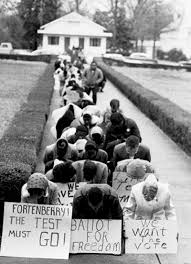
The Civil Rights movement was the background context of the lives of the young Supremes. The campaign’s employment of a variety of nonviolent confrontation tactics took place in ordinary locations which would have appeared as familiar territory to any teenager: kneel- ins at churches, sit-ins at lunch counters and on parks, beaches, libraries, theaters, museums, and other public places.

There was a “walk to freedom” in Detroit in 1963. 


On Palm Sunday 1964, at the Second Presbyterian Church in Memphis, Tennessee, a group of black and white students began a "kneel-in" to protest the church's policy of segregation-a protest that would continue in one form or another for more than a year and eventually force the church to open its doors to black worshippers. "Kneel-ins" were the strategy of choice for bringing attention to segregationist policies in Southern churches. These protests involved surprise visits to targeted churches, usually during Easter season, and often resulted in physical standoffs. The spectacle of kneeling worshippers barred from entering the church made for a powerful image, and invited both local and national media attention. 


The situation intensified in USA at precisely the same time the Supremes were on their United Kingdom tour with the Motown Hitsville Show. 

On Sunday, March 7 1965, Hosea Williams and John Lewis led a march of 525 pilgrims, who intended to walk the 54 miles from Selma to the state capital in Montgomery. Only six blocks into the march, however, at the Edmund Pettus Bridge on Jefferson Davis Highway, Alabama state troopers and local law enforcement officers attacked the peaceful demonstrators with billy clubs, tear gas, rubber tubes wrapped in barbed wire, and bull whips. The defenseless marchers were driven back into Selma. John Lewis was knocked unconscious and dragged to safety, while at least 16 other marchers were hospitalized.


Meanwhile, in preparation for their scaling the heights of commercial success, the Supremes undertook a special ‘Artist Development’ programme similar to the Hollywood charm schools of the 30s and 40s. Maxine Powell gave lessons on the proper way to dress, eat, sit, walk and how to appear on television. 

The Supremes appeared at the Hammersmith Palais on March 21st 1965.

http://www.vam.ac.uk/content/articles/t/the-story-of-the-supremes-from-the-mary-wilson-collection/


Bibliography


http://www.motownmuseum.org/story/motown/


http://americanhistory.si.edu/blog/negro-motorists-green-book

http://www.blackpast.org/aah/negro-motorist-green-book-1936-1964